Americans scroll past hundreds of digital ads every day, and most of them barely register. Ads interrupt videos, pop-ups clutter web pages, and the same products seem to follow shoppers from site to site. After years of this constant digital noise, many people have started tuning it out entirely. Yet print advertising has remained surprisingly powerful, capturing attention and driving action in ways digital ads often can’t.
To understand how this fatigue is reshaping advertising, Hopkins Printing surveyed 1,013 Americans about their experiences with digital and print ads. The results show that even as digital ads multiply, print is holding onto something digital has lost: consumer trust.
Key Findings
- Over 1 in 4 Americans prefer print advertising over digital advertising
- 46% trust print advertising more than digital advertising
- 98% of Americans believe consumers are seeing too many digital ads today
- 98% of Americans intentionally ignore or avoid digital advertisements, of those 77% ignore them daily
- Nearly 2 in 3 believe print advertising is more effective because consumers are tired of digital ads
- More than 3 in 4 have made a purchase after seeing a printed advertisement
98% of Americans Believe Consumers Are Seeing Too Many Digital Ads Today
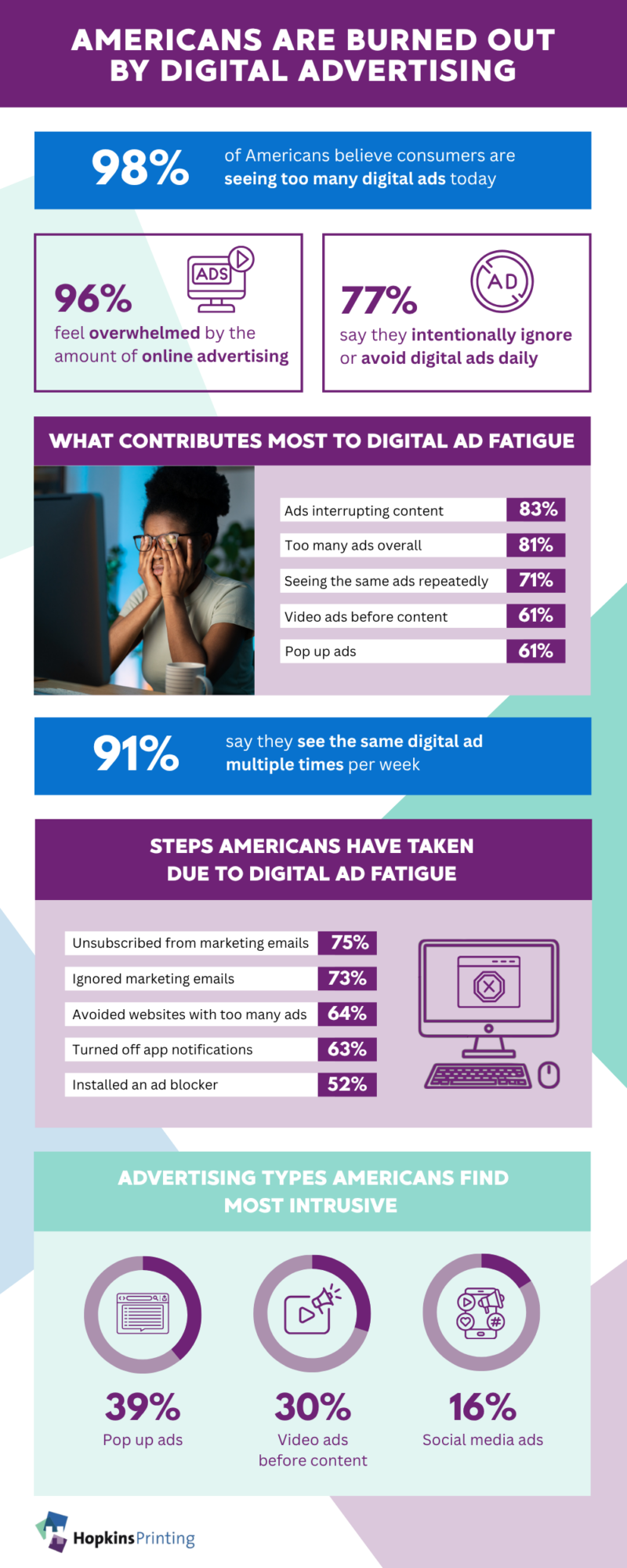
Fatigue from digital advertising has become the norm. Nearly all respondents (98%) say that consumers are seeing too many digital ads today, and 96% say they feel overwhelmed by online advertising. 25% feel overwhelmed by online ads daily, 33% feel this way often, and 38% feel it at least sometimes.
What’s Causing Digital Ad Fatigue
Several factors are wearing consumers down, and most of them center on one theme: overload. Survey respondents identified the following factors as the biggest contributors to their digital ad fatigue:
- Ads interrupting content – 83%
- Too many ads overall – 81%
- Seeing the same ads repeatedly – 71%
- Pop-up ads – 61%
- Video ads before content – 61%
- Excessive email marketing – 54%
- Ads that follow shoppers around online – 51%
Americans also identified several other contributors to digital advertising fatigue, including sponsored content disguised as regular content (47%), irrelevant ads (46%), inauthentic influencer promotions (40%), and excessive text message marketing (35%).
When asked what their biggest frustration with digital advertising is, 33% say there is too much of it, and 29% said it interrupts what they’re doing. Another 13% said it feels invasive, while 10% said it follows them around the internet. The types of digital advertising Americans feel are most intrusive include pop-up ads (39%), video ads before content (30%), and social media ads (16%).
It’s no surprise then that 91% of Americans see the same digital ad multiple times in a single week. Of those, 39% report encountering the same ads online every day.
Steps Americans Are Taking To Combat Digital Ad Fatigue
Fatigue has pushed most Americans to take action. In fact, 98% intentionally ignore or avoid digital ads. 77% do so every day, with another 17% doing so multiple times a week. Here are the steps Americans have taken due to digital ad fatigue:
- Unsubscribed from marketing emails – 75%
- Ignored marketing emails – 73%
- Avoided websites with too many ads – 64%
- Turned off app notifications – 63%
- Installed an ad blocker – 52%
- Paid for an ad-free subscription – 32%
- Deleted a social media app – 25%
46% of Americans Trust Print Ads More Than Digital Ads
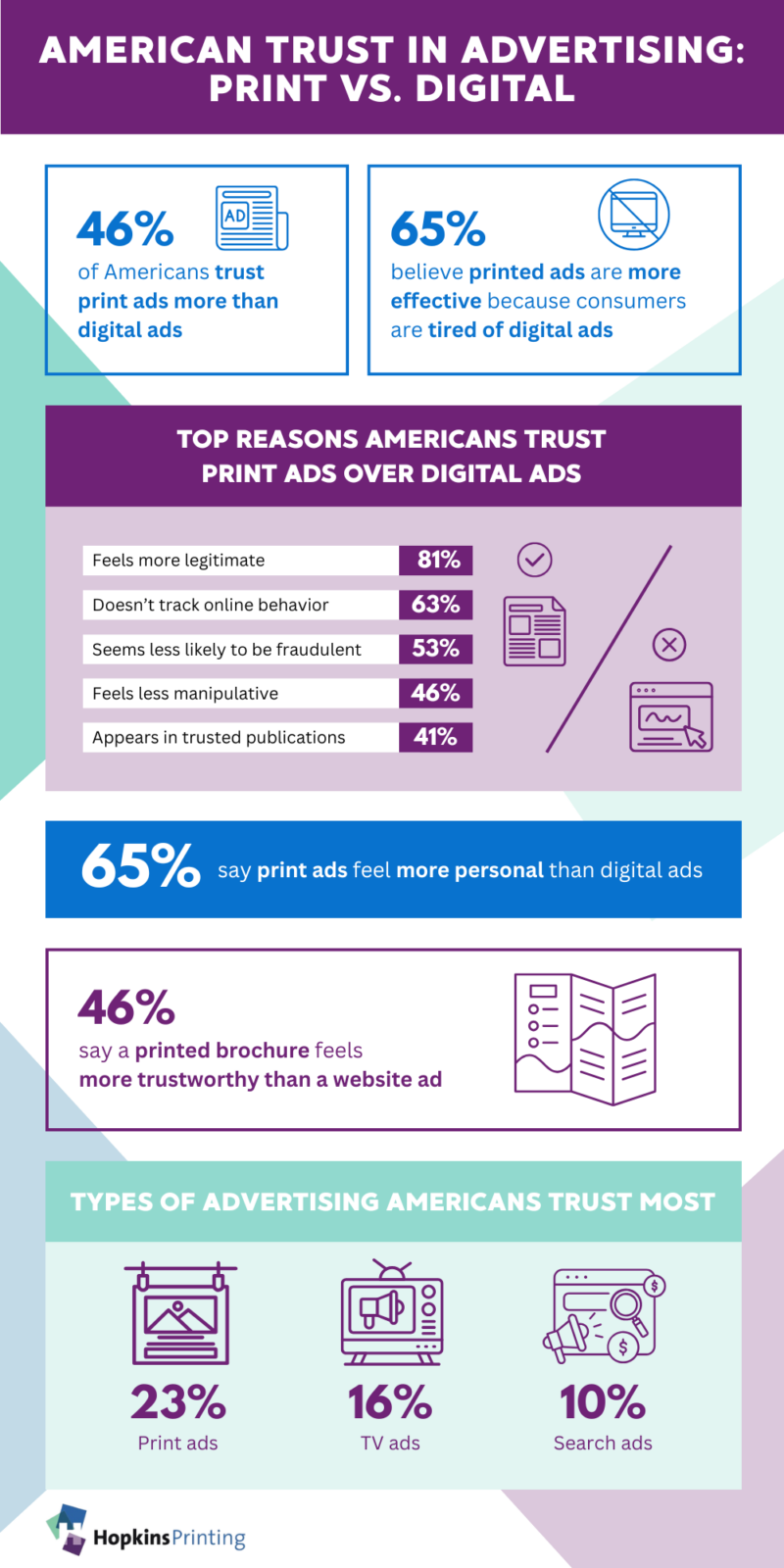
As digital fatigue grows, trust in print advertising is holding strong. 46% of Americans say they trust print ads more than digital ads, and only 3% say the opposite. The remaining 51% trust both equally. When asked which advertising type feels most trustworthy, print ads led at 23%, followed by TV ads (16%) and search ads (10%). However, some consumers still remain skeptical, as 23% said none of the advertising formats feel trustworthy.
When asked which feels more trustworthy, a printed brochure or a website ad, 51% chose the brochure. Another 22% said both feel equally trustworthy, and 22% said neither.
Why Print Feels More Trustworthy
Trust in advertising comes down to how an ad makes people feel and whether they believe what it’s telling them. The top reasons Americans believe print ads are more trustworthy than digital ads include:
- Feels more legitimate – 81%
- Doesn’t track online behavior – 63%
- Seems less likely to be fraudulent – 53%
- Feels less manipulative – 46%
- Appears in trusted publications – 41%
- Less cluttered – 26%
These perceptions may also be influencing how Americans view advertising effectiveness overall. Nearly 2 in 3 respondents (65%) believe print advertising is more effective because consumers are tired of digital ads.
Nostalgia for Traditional Print Media Runs Deep
Print advertising taps into something more emotional. When asked whether printed ads feel more personal than digital ads, 65% of respondents said yes, while just 35% said no.
Many Americans also feel nostalgic for traditional forms of print media. Magazines top the list (47%), followed by printed coupons (42%), printed catalogs (38%), newspaper inserts (32%), community newspapers (24%), and direct mail catalogs (23%). Only 21% say they do not feel nostalgic for any of these formats.
That sentiment is shaping advertising preferences. 26% of Americans say they prefer print advertising overall, while 30% like a mix of both print and digital formats. Meanwhile, 36% say they dislike advertising in general, regardless of format.
76% of Americans Have Made a Purchase After Seeing a Printed Advertisement
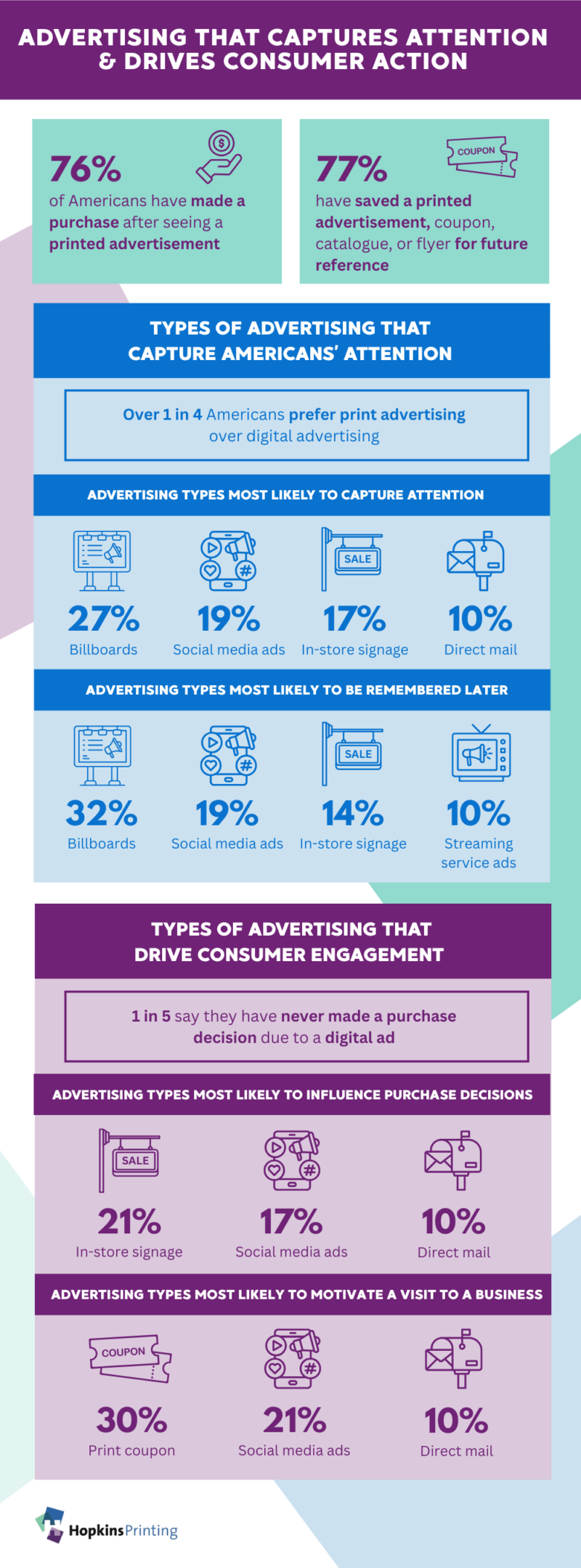
Print advertising also drives real consumer action. 76% of Americans say they have made a purchase after seeing a printed ad. On the other side, 1 in 5 (20%) say they have never made a purchase because of a digital ad.
Types of Advertising That Capture Attention
When asked which type of advertising is most likely to catch their attention, Americans most often pointed to billboards (27%). Social media ads followed at 19%, while 17% selected in-store signage and displays and 10% chose direct mail.
Print advertising also leaves a lasting impression on consumers. Billboards were the advertising format respondents said they would be most likely to remember later (32%), followed by social media ads (19%), in-store signage and displays (14%), and streaming service ads (10%).
Direct mail still earns a second look in many households. When Americans receive an appealing piece of direct mail, 34% read it immediately and 29% save it for later, while 13% visit the business’s website. 77% of Americans say they have saved a printed advertisement, coupon, catalog, or flyer for future reference. Among those who save them, 14% do so weekly, 32% monthly, 27% every three months, and 25% once or twice a year.
Types of Advertising That Drive Consumer Action
When it comes to influencing an actual purchase, in-store signage leads at 21%, followed by social media ads (17%) and direct mail (10%). Print coupons are especially persuasive when it comes to getting people through the door. 30% say a printed coupon is most likely to spark a business visit. Social media ads follow at 21%, direct mail at 11%, and TV or streaming ads at 10%.
Social media ads lead when it comes to inspiring people to learn more about a product, at 27%. Print coupons follow at 17%, with search ads and streaming ads tied at 12% each, and direct mail at 10%.
Print Advertising Cuts Through Digital Chatter
Print advertising isn’t disappearing anytime soon. From billboards that stop traffic to direct mail saved for months, print continues to capture attention and drive action in less invasive and more memorable ways.
For businesses looking to cut through the noise and earn that trust, Hopkins Printing offers professional printing services that make every piece count. Contact Hopkins Printing today to start creating advertising that customers actually want to see.
Methodology
In June of 2026, we surveyed 1,013 Americans on their thoughts about print vs. digital advertising and their experience with digital fatigue and ad overload. Among respondents, 49% were female, 50% were male, and 1% were non-binary. The age of respondents ranged from 18 to 83, with an average age of 39.
For media inquiries, please contact media@digitalthirdcoast.net